Author Archives: debbie

  1. You’re responsible for Sexual Harassment at Work

    Comments Off on You’re responsible for Sexual Harassment at Work

    I don’t mean that headline as an accusation, it is a warning of what is to come. In the wake of the #MeToo campaign, the Government have been considering ways to prevent sexual harassment.  As someone who has experienced it a number of times during my working career, I say it’s about time.

    The Government have announced their intention to make employers:

    • take “all reasonable steps” to prevent sexual harassment
    • require employers to take “explicit measures” to protect their staff from third party harassment.

    There is also the possibility that the time limit to bring a tribunal claim may be extended from 3 months to 6 months (for claims under the Equality Act).

    What is sexual harassment?

    Sexual harassment is defined as unwanted behaviour of a sexual nature.  It has the purpose or effect of “violating someone’s dignity, creating an intimidating, hostile, degrading, humiliating or offensive environment for the individual concerned”. Note, it is about how the recipient feels, not how the act was intended.  “Banter” is no defence.

    At age 15, I worked in a shop where the staff room was wallpapered with porn.  On my first day at a new employer in the City, I walked into wolf whistles on the trading floor.  No one said a word.  Just 3 years ago, someone stopped me on my way to a client and asked about my underwear.   Honestly, at my age I thought that was one thing I no longer needed to deal with.

    Sexual harassment can mean many things. It can include things like comments made, inappropriate touching or staring, social media posts or even stalking.  If you wouldn’t be happy if the act happened to your parent, your partner or your child, it’s probably not appropriate.


    What can employers do to stop it?

    One of the things the #MeToo campaign highlighted was just how embarrassed victims of sexual harassment feel.   They tend to wonder if they are going to be believed and may find it easier to leave a job, than make a fuss.  To protect your team and prevent harassment, you need to take the following steps:

    • Make it clear to everyone who works for you or uses your services, that you will not tolerate sexual harassment.
    • Provide appropriate training – management need to know how to recognise, deal with and prevent it.
    • Raise awareness – what is harassment? What should people do if they are concerned?
    • Have regular reviews with your team.  Encourage them to share anything that is making them feel uncomfortable.
    • Deal promptly with any allegations or concerns.
    • Offer support to anyone involved in a complaint.


    Why wait until the legislation comes in to take action in this important area? For more information, please contact me.

  2. How to attract good candidates without breaking the bank

    Comments Off on How to attract good candidates without breaking the bank

    Recruitment can be a challenge at the best of times but recruitment in a worldwide pandemic with an unpredictable economy?  That is a real challenge many businesses are facing right now. So how do you attract good candidates without breaking the bank? Here are my five top tips…

    What does the company need?

    Firstly, it’s important to evaluate the role. Is it a new or existing role? If so, do you really need someone full-time? Could part-time hours or a job share work? Could the duties be distributed to existing employees? These may seem like obvious questions but it’s easy to replace jobs as a like for like so consider what the company actually needs.

    Once this has been established, look in-house! Could you up-skill an existing employee? Could you put a referral scheme in place if an employee recommends a friend for the job?


    Sell your story

    Every company has a story behind it. Attract good candidates by sharing your story and making it relatable. Be completely open about the company’s mission, values and culture. Going to work isn’t about just doing a job. Prospective candidates want to know who they are working for, what they get in return, and they want to ensure the company’s values align with their own. Selling the story of the company is as equally important as the candidate selling themselves. Recruitment is a two-way decision.


    Raise your online profile

    Social media is huge now so make sure your company is visible. A vast majority of jobseekers will be active on social media or the internet at the very least, so it’s important to raise the company profile wherever it’s listed but especially on professional networking sites such as LinkedIn and Indeed. There are so many options to list jobs free on social media but the real benefit here is that you reach a much wider audience to attract good candidates than job boards alone.


    Flexible and/or remote working

    We have seen a huge rise in flexible and remote working since the start of COVID19. Giving employees the flexibility to balance their home and work life is an incredibly attractive benefit. It increases the pool of candidates by radius and makes long distance commutes much more sustainable. In this day and age, having a good reputation for a healthy work/life balance is a great place to be.


    Attract good candidate with great opportunities

    Offer development and career progression opportunities where possible. Not only is it attractive to a prospective employee, but you are also likely to stand in a better position when it comes to employee retention too. Offering training courses or learning materials is a great way to attract good candidates because it shows that you’re invested in employee development.  With grants and levy’s available for many, this could be an attractive benefit with very little cost.


    Best of luck in finding the great candidates you need. If you need any further support, please contact me.

  3. The Cost of Conflict at Work

    Comments Off on The Cost of Conflict at Work

    Many businesses experience conflict at work.  While some disagreement can lead to healthy debate, conflict can be disruptive.  According to a new ACAS report, it can also be extremely costly.

    ACAS’ report, “Estimating the cost of workplace conflict“, has some sobering statistics.  It found:

    • In 2018  – 2019, 9.7 million UK employees experienced conflict at work.  The working population is c31 million people.
    • Only 5% of those people resigned.
    • The cost of recruiting and training their replacements was estimated to be £14.9 billion.
    • 40% of those that remained in their jobs, said they felt less motivated as a result.
    • Conflict related sickness absence cost £2.2 billion.
    • The management time spent dealing with employment tribunals cost c£282 million per year.
    • With another £264 million spent on legal fees.

    Conflict at work leads to poor morale, staff turnover and costs to your business.


    Potential Causes

    We all have our own history and beliefs that influence the way we look at things.  Some things that seem unimportant to us can be hugely significant to others.  Football is a prime example.  Many people have been glued to the Euros. Others can’t wait for them to be over.

    That’s the same with work.  One person’s necessary improvement can be another person’s unreasonable criticism.  Conflict can arise from many areas including:

    • resistance to change
    • ineffective communication
    • unrealistic expectations
    • poor work habits
    • personality clashes
    • poor working environment

    Potentially, returning from furlough may be a source of conflict.  “You’ve had all this time off while we have been working” V “everything has changed and everyone expects me just to get on with it”.


    Dealing with Conflict

    Conflict needs to be nipped in the bud.  If it isn’t, it can escalate and infect other people.

    Speak individually to those involved. Find out what is happening and what is concerning them.  Listen carefully and you may be pleasantly surprised at how small adjustments can make a big difference.

    Sometimes, encouraging them to understand another’s perception can be helpful.  Again, back to the football. As an Arsenal supporter, I cannot understand anyone wanting Spurs to win.  Spurs fans would, of course, not agree.  Our perceptions of exactly the same thing are completely different.  To a Chelsea fan, we are both wrong.

    If you have tried to resolve matters yourself and conflict still exists, you may want to try Mediation.  Mediation has proved to be a very effective way of resolving disputes informally and one where the parties stay in control.


    If you are experiencing a workplace conflict or would like to find out more about mediation, please contact me.

  4. What to do if your employee refuses to return to work

    Comments Off on What to do if your employee refuses to return to work

    At long last, we can see signs of normality returning.  We can go back to shops, restaurants and even football stadiums.  Employers are reopening their workplaces.  However, what can you do if your employee refuses to return?  It’s a question I am increasingly being asked.

    For many businesses, long-term or indefinite homeworking may not be sustainable.  Equally, some employees cannot wait to escape working from their bedrooms.  For many, “going to work” has taken on a completely different meaning over the last 18 months.  While some welcome getting back to the office, others have no wish to do so.

    Consider why your employee refuses to return

    Covid-19 has had such a big impact across the globe and has affected people in different ways. The first thing to consider is why your employee refuses to return to the workplace. This could be one of many reasons including:


    • Anxieties around catching Covid-19 in the workplace.
    • The employee or someone they live with is considered clinically vulnerable.
    • They want to be fully vaccinated before returning to the workplace.
    • Their personal circumstances have changed.  Office working is no longer suitable for them.
    • The luxury of no travel. I don’t think anyone has missed the rush hour.
    • Change! They simply enjoy working from home and don’t see why they need to go back.


    Understanding why your employee refuses to return is a key first step.  Push too hard and you may lose a valued employee.  Work together to understand and address their concerns, you may find you have a more engaged employee, moving forward.  Proceed with caution, sensitively and flexibly where possible.


    What are the business requirements?

    From a business perspective, it’s important to consider the needs of the business. Does home working have a negative impact on the business? Could the business make it work? Given the current circumstances, send your employees a questionnaire to gather their input to help your decision making going forward.

    Once you have established the business needs, consider the individual needs of those who are refusing to return. What are their reasons and how can you support them? Could you meet in the middle with partial home working or a temporary solution and a phased return to work?


    What does the legislation say?

    If you have considered the above with no signs of progressing the conversation further, you can suggest the employee submits a flexible working request.  As with all flexible working requests, this should be considered in a reasonable manner and can only be refused, if you can demonstrate one of the eight reasons below:


    • Extra costs that will damage the business.
    • The work cannot be reorganised among other staff.
    • People cannot be recruited to do the work.
    • Flexible working will affect quality and performance.
    • The business will not be able to meet customer demand.
    • There’s a lack of work to do during the proposed working times.
    • The business is planning changes to the workforce.


    Being flexible, understanding and supportive may help you and your employee to reach the balance you need.  However, if you cannot reach a position that works for the business and your employee still refuses to return to the workplace, please contact me.

  5. New Holiday Headaches for Employers

    Comments Off on New Holiday Headaches for Employers

    The one thing that every one of us can agree on, I’m sure, is that we would like a holiday.  Preferably to somewhere warm and sunny.   However, this year is likely to present a whole new host of holiday challenges for employers.


    Overseas Travel

     At the time of writing, UK citizens are banned from all but essential travel abroad.  When that ban is lifted, it is likely we will be required to self-isolate on arrival back in the UK.

    I expect that, when restrictions are eased, there will be a rush of people looking to holiday abroad.  This will be on top of all those holidays that have been postponed from last year.  The requirement to self-isolate could prove to be a significant issue for those that cannot work from home.

    When it comes to agreeing holiday requests, you need to find out if they plan to travel abroad and if so, when and where they are going.   Are they allowing a period for self-isolation after they return?  Are they just hoping they won’t need to?  If there is one thing we have learnt from this pandemic it is to plan for the worst.  Assuming they must self-isolate, what do you need to have in place?

    If this will affect you, adjust your holiday booking processes now to find out this essential information.


    Holiday carry over

    You may have agreed to your employees carrying over additional leave they were not able to take last year due to COVID.  Some employees may have up to 20 additional days, which must be used within 2 years.  You cannot pay them for any holiday they have not used unless they are leaving your employment.

    If you have allowed your employees to carry over a substantial amount of holiday, think carefully about how you want them to take this.  If you let the situation drift you could be faced with a larger than normal backlog of holidays and/or a big bill when someone leaves your employment.

    You can require employees to take leave when you tell them to, provided you give twice as much notice as the amount of leave you require them to take.  If they are on furlough at the time, you must top their pay up to 100% of salary.


    Using Up Holiday Entitlement

    The Government are actively discouraging people from booking summer holidays abroad.  Your sunseekers may be banking on the situation changing later in the year.

    As we approach the end of any holiday year, there is often a panic to use up holiday entitlement. If people delay taking their main holidays to go abroad, this headache could be worse than ever.  Set yourself some targets throughout the year as to how much holiday you expect people to take and by when.

    As with all annual leave, it is up to you to agree when they take it.  You can say “no”.  You may need to if you see there is going to be an overlap of key employees due to potential isolation issues. No one likes their holiday request being turned down, particularly after the difficult year we have all had.   Make it clear to your employees that the likelihood of isolation is something you have to take into account.  They should therefore make their requests early and not book anything before their holiday request has been approved.


    This year it is not just your employees that need to plan for their holidays.  Take the time now to put new processes in place and make your employees aware of the particular difficulties you face. If you need any support with this, please contact me.

  6. Can I employ EU citizens after Brexit?

    Comments Off on Can I employ EU citizens after Brexit?

    Now that Brexit has happened, most EU citizens no longer have the automatic right to work in the UK. Irish Nationals are the exception.  So how can you employ EU Nationals in the UK?

    Settled Status

    EU nationals who started living in the UK before 31 December 2020 should apply for settled status. They have until 30 June 2021 to do so.  Once they have this, they are entitled to live and work in the UK.

    There are two types of status, depending upon how long the person has lived in the UK:

    • Five continuous years or more – Settled Status
    • Less than five continuous years – Pre-settled Status*

    *Once they have lived in the UK for five continuous years, they can apply for Settled Status.

    The scheme is free of charge. Encourage your employees to apply for it now. Without this, as of 1 July 2021, you will not be able to employ them.

    What if they don’t have settled status?

    If your new employee does not have settled status, it may be that they just haven’t applied for it yet.  As they have until 30 June 2021 to do so, you can’t withdraw their offer – it could be discrimination.  However, if they settled in the UK after 31 December 2020, they won’t be eligible for settled status.  Potentially you could employ someone you later find never had the right to work in the UK.  If you find yourself in this situation, please contact me before reacting. You will still need to go through a fair procedure.

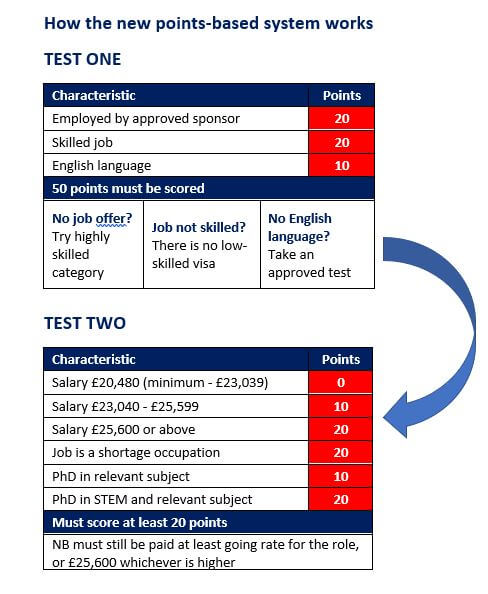
    The UK will operate a points-based system for EU Nationals from January 2021.  To be granted a visa, the applicant will need to achieve 50 points under test one, plus at least 20 points under test two, as follows:

    To bring people into the UK under this system, your business will also need to be a sponsor.

    To become a Sponsor

    If you want to become a sponsor, I would strongly suggest you start looking into this now. Don’t wait until you have found a great candidate, I promise you frustration if you do.

    There are additional costs you need to be aware of, such as:

    • the cost of becoming a sponsor
    • the cost of each visa is currently £1,000 per year for a Tier Two migrant
    • potential wage inflation costs to meet minimum wage levels
    • the immigration health surcharge, if you choose to pay it on their behalf

    The Home Office estimates that 70% of EU workers currently in the UK would not meet the requirements for a visa under the new scheme. In other words, it is likely to be much more difficult, expensive and in some cases, impossible to employ EU nationals in certain roles.

    Actions you should take now

    I would strongly encourage you to look ahead and prepare:

    • make those that recruit aware of these changes
    • audit your files to see which employees this will affect
    • make all staff aware of this scheme. It may affect relatives too
    • strongly encourage people to apply for settlement status, if eligible
    • ask for evidence of settled status, once achieved
    • assess how you would have coped, had you not been able to employ EU citizens
    • are you likely to want to sponsor EU citizens in the future? If so, apply to become a sponsor now
    • review how you source, train and retain talent

    If you need any support on this, please call me.


  7. How to write a successful job advert

    Comments Off on How to write a successful job advert

    A hair salon recently placed an advert with JobCentre Plus for a new stylist. The advert said that they were “a happy salon looking for happy people”. Within the hour, the salon owner received a call saying they could not place the advert as it was discriminatory. I was once told I couldn’t advertise for someone who had a “smart appearance”. Why?

    waiting-job-advert


    Be wary of discrimination

    You must not discriminate on the basis of:

    • Age
    • Sex
    • Sexual orientation
    • Gender reassignment
    • Race
    • Religion or belief
    • Marriage/Civil Partnership
    • Disability
    • Pregnancy and maternity leave

    It’s ok to say that someone must be “happy” but you must avoid anything that suggests an intention to discriminate.  For instance, you should avoid:

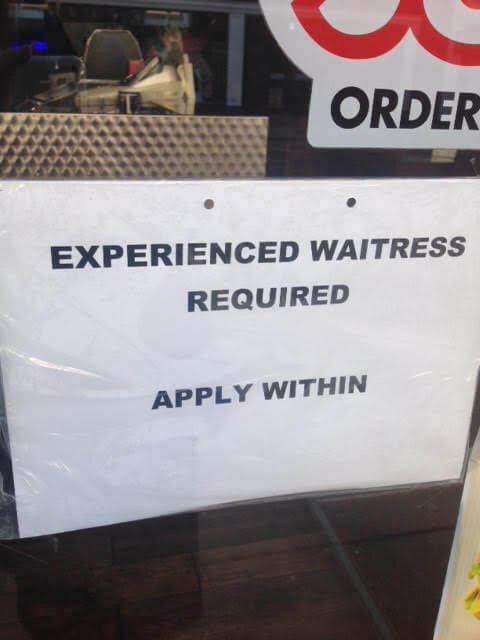
    • Gender or age specific words such as “waitress” and “junior”.
    • Phrases like “must be physically fit”.  Detail the tasks they are required to do instead.
    • Advertising to a limited audience.  For example, in a men’s magazine.


    Preparing to write a job advert

    It is fair to say that it is a recruiter’s market at the moment.  Some excellent people have lost their jobs due to COVID.

    Before you write a job advert, think carefully.  Your instinct may be to replace like for like.  We have all been through a difficult 6 months.  What you truly need now may be very different to what you had before.

    Start with a blank piece of paper. Write a new job description for the role.  What knowledge, skills and attributes do you need?  Which are essential?  Which are “nice to haves”?

    Can things be done a little differently?  For instance, if you have found that working from home has been great for you, can your new recruit do this too?  If so, you are no longer limited to those that can commute to you.

    Think about where you want to advertise.  There are a wealth of job boards available.  Which are the most appropriate to your vacancy?  Where would you expect them to look?  Can you use social media?


    What should be in a job advert?

    • Adverts need to be clear, easy to read and attention grabbing.
    • Many people will read your advert on their phone.  They will quickly decide whether to scroll down further or move to the next advert.  Key features such as job title, salary and location should be in bold at the top of your advert.
    • Get to the point.  One short summary sentence of your business is enough.  If they want to know more they can go to your website.
    • Put yourself in their shoes.  What is in it for them?
    • Be honest about the role.  Don’t waste your time recruiting someone who could leave if they find the job is not what they thought it would be.
    • Is there anything your candidates have to have?  For example, a driving license or a particular qualification.  This will reduce unsuitable applications.
    • Tell people how to apply and if there is any deadline.

    If you are in the fortunate position that you need to recruit, there is a lot of great talent currently available.  Please contact me if you need any support.