Author Archives: debbie

  1. T Levels – What are they and why get involved?

    Comments Off on T Levels – What are they and why get involved?

    T Levels are the new alternative to A Levels.  Learning time will be split 80% classroom: 20% hands on with an employer.  It’s well worth taking a closer look.
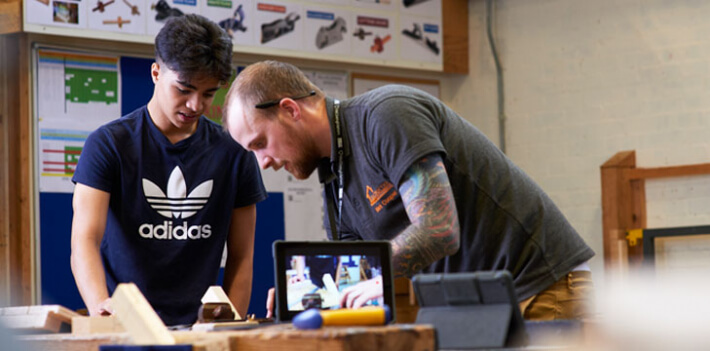
    T-Levels-the-new-alternative-to-A-Levels


    What T Levels are available?

    T Levels are available in:

    • Agriculture, environmental and animal care
    • Business and administration
    • Catering and hospitality
    • Construction
    • Creative and design
    • Digital and IT
    • Education and childcare
    • Engineering and manufacturing
    • Hair and beauty
    • Health and science
    • Legal, finance and accounting

    Why should I get involved?

    Giving work opportunities to young people can be hugely rewarding.  As well as helping young people from diverse backgrounds join your industry, you may find some real talent.

    You will also:

    • Help your managers develop their mentoring skills.
    • Gain fresh ideas for your business.
    • Build partnerships with local training providers.

    T Levels Placement

    T Levels take place over 2 years and are equivalent to 3 A Levels.  Placements last for a minimum of 315 hours (c 45 days).  This can be longer – depending on the subject.

    Placements can be offered in a variety of ways, depending on what works best for you.  You may prefer a block, a series of blocks, day release or a mix.

    This is different to an apprenticeships.  There around 80% of the time is spent in a work placement.  Work experience placements are usually shorter and more basic.

    Your Responsibilities

    To be able to offer a placement, you need:

    • A safe work environment
    • Opportunities for the student to develop their technical skills
    • A line manager to support, supervise and mentor
    • To provide formal feedback against agreed learning goals.
    • You are not required to pay the student. You may choose to do so or contribute towards their expenses.
    • You will need to notify your insurer.

    Learning goals are agreed with the training provider before the placement begins.  They can also help you with any upfront costs, such as for providing PPE.

    How do I get involved?

    If you would like to get involved with this scheme, please contact NAS on 08000 150 600 or email tlevel.placement@education.gov.uk
  2. Who remembers Brexit? Apply now for Settled Status

    Comments Off on Who remembers Brexit? Apply now for Settled Status

    While our minds have rightly been elsewhere, time is ticking towards Brexit. I never thought I would say that. Slipping under the radar is the effect this will have on EU nationals and their right to work in the UK.

    With effect from 1 January 2021 major changes are coming. Other than Irish citizens, EU nationals will need a visa to work in the UK. From past experience, this will not be easy. Happily for the many EU citizens that already live and/or work in the UK, there is an alternative. One that you should encourage your employees to apply for, now.

    Settled Status

    EU nationals who started living in the UK before 31 December 2020 should apply for settled status. They have until 30 June 2021 to do so. Once granted, they will not need a visa. This doesn’t just apply to people who work. It applies to their family members too.

    There are two types of status, depending upon how long the person has lived in the UK:

    • Five continuous years or more – Settled Status
    • Less than five continuous years – Pre-settled Status*

    *Once they have lived in the UK for five continuous years, they can apply for Settled Status.

    The scheme is free of charge. Encourage your employees to apply for it now. Without this, as of 1 July 2021, you will not be able to employ them.

    What if they don’t have settled status?

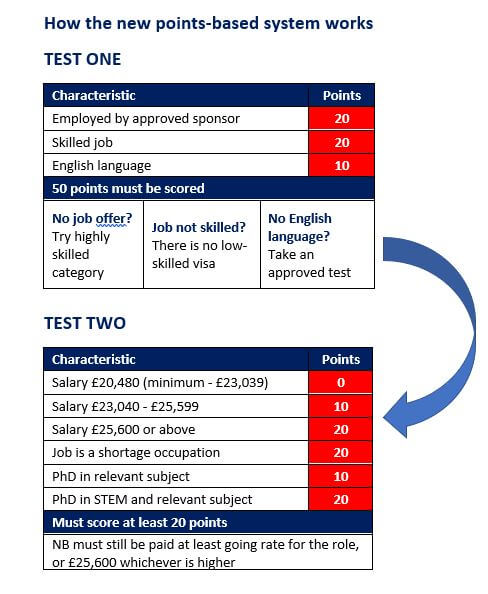
    The UK currently operates a points-based system for skilled overseas workers. In a manner of speaking, this system will be extended to EU Nationals from January 2021.

    To be granted a visa, the applicant will need to achieve 50 points under test one, plus at least 20 points under test two, as follows:

    To bring people into the UK under this system, your business will also need to be a sponsor.

    To become a Sponsor

    If you want to become a sponsor, I would strongly suggest you start looking into this now. Don’t wait until you have found a great candidate, I promise you frustration if you do.

    There are additional costs you need to be aware of, such as:

    • The cost of becoming a sponsor
    • The cost of each visa. Currently £1,000 per year for a Tier Two migrant
    • Potential wage inflation costs to meet minimum wage levels
    • The immigration health surcharge, if you choose to pay it on their behalf

    The Home Office estimates that 70% of EU workers currently in the UK would not meet the requirements for a visa under the new scheme. In other words, it is likely to be much more difficult, expensive and in some cases, impossible to employ EU nationals in certain roles.

    Actions you should take now

    I would strongly encourage you to look ahead and prepare:

    • Audit your files to see which employees this will affect
    • Make all staff aware of this scheme. It may affect relatives too
    • Strongly encourage people to apply
    • Ask for evidence of settled status, once achieved
    • Assess how you would have coped, had you not been able to employ EU Nationals this year
    • Are you likely to want to sponsor EU Nationals in the future?
    • If so, apply to become a sponsor now
    • Review how you source, train and retain talent

    I understand that Brexit maybe the last thing on your mind right now.  It is just around the corner.  If you need any support on this, please call me.


  3. A Flexible Return to Work

    Comments Off on A Flexible Return to Work

    Your business has, no doubt, been through a lot recently and your way of working has probably changed. Many staff have had to work from home and I expect a lot more of them will be asking for flexible working. What does that mean to you?

    Who can make a flexible working request?

    Any employee with 26 weeks’ service can make a flexible working request. They can do this once a year. For instance, they might want to work different hours or to work from home. Both things you could have asked them to do as part of your response to COVID-19.


    What should I do if I receive a flexible working request?

    You must deal with each request “reasonably”. This means thinking about “how can I make this work?” rather than “how can I say no?” Thanks to Coronavirus, many of us have had to make changes work. We have had to overcome issues with technology, virtual meetings and sharing documents online. If it worked during COVID-19, why can’t it be part of the new normal?

    Ask your employee to complete a flexible working request form. This will clarify what they are looking for. Your employee will also be asked to consider how their request will affect the business and how to overcome this. Arrange to meet your employee to discuss the form.  If you can agree to their request, great. Always confirm any changes in writing.

    If you are concerned that you cannot agree to the changes they want, discuss your concerns at the meeting. You might be able to agree a compromise. You could have a trial period. If so, say when the trial period will end and what will happen if it is unsuccessful.


    What if I can’t agree to a flexible working request?

    You can only turn down a flexible working request on one or more of the following grounds:

    • extra costs will damage the business
    • the work cannot be reorganised among the staff
    • people cannot be recruited to do the work
    • flexible working will affect quality and performance
    • the business will not be able to meet customer demand
    • there is a lack of work to do in the proposed times
    • the business is planning changes to the workforce.

    It will be very difficult to refuse a flexible working request, if it worked during COVID-19. If you find yourself in this situation, please contact me for advice.


    Will this set a precedent?

    Whenever you receive a flexible working request, you must consider it in the current circumstances. Let’s say you had three shop assistants. One asked to finish at 3pm each day to pick up their children from school. You considered this and agreed. There was sufficient cover from the other two assistants.

    A colleague decided they would like to leave at 3pm each day too. This would now leave you with one person only in the shop after 3pm. That would not be enough cover. You don’t have to agree because you allowed the first shop assistant to reduce their hours. You consider each request in the current circumstances.

    Flexible working can be a wonderful tool to help your employees get a better work/life balance. In turn, this may make their time in work more productive. Huge changes have been forced upon us by COVID-19. Perhaps some of these changes will be beneficial after all. If you need any support with this, please do not hesitate to contact me.

  4. What happens when furlough ends?

    Comments Off on What happens when furlough ends?

    Employment Lawyer, Tosh Polpityre, describes furlough as similar to when President Kennedy said America would put a man on the moon. NASA had to make it happen. The Chancellor announced the Job Retention Scheme and the Civil Service had to make it happen. The trouble is, the more people thought about it, the more changes were introduced. I feel I have talked of nothing else all month. 

    Keeping in touch

    Under the Job Retention Scheme you can “furlough” staff. Your employees must not do any work for you at all while they are furloughed. You should, however, keep in touch with them. Let them know they are still part of the team and check in on how they are doing. Hold virtual socials. It is important to keep team spirit strong.

    Provided they don’t provide a service or generate a revenue, you can hold training sessions. Let’s be ready to hit the ground running when things recover.

    What happens when furlough ends?

    The Scheme is now available until 30 June 2020. Employers can recall their staff from furlough at any time. Each period of furlough must last for a minimum of three weeks.

    One day, the furlough scheme will close. What happens then? Put simply, there are three main scenarios I see:

    • Staff come back to work
    • Fewer jobs are available and you’ll need to make redundancies
    • Staff choose not to return to work

    All of these scenarios could be problematic.

    Back to work

    It would be great if things picked where they left off. Have you thought about how you will achieve that?

    • What work will there be to do?
    • Will your team need any refresher training?
    • How do you bring furloughed staff up to speed?
    • What lessons have you learned?
    • What have you done differently that worked really well?
    • What have you found you no longer need to do?
    • How do you thank those that kept your business running?
    • If this virus re-emerges, what would you want to be in place?
    • How do you deal with the mixture of those that were furloughed and those that were not?

    That last point really concerns me as I see it as a potential source of conflict. Those that have been furloughed have not been allowed to work. They may have felt rejected, isolated and have had less income. They could feel out of the loop and tales of how busy someone has been may be seen as a dig at them.

    Those that have carried on working may have resented having to do extra work. They may be exhausted and innocent tales of boredom or comments about things being missed may cause friction.

    Brief people to be mindful of other’s feelings. Consider how you can integrate the two again and stress how important both their roles have been. If possible, you may want to consider giving some extra time off to those who have worked particularly hard to support your business over these difficult weeks.

    Jobs no longer being available

    The Job Retention Scheme is likely to stop before many businesses recover. I’ve already had a number of conversations about redundancies. At a time like this, transparency is important. The job market will be hard and keeping people informed will give them more chance to prepare.

    Redundancy is a form of dismissal. You must follow a fair process. This includes:

    • Identifying which role(s) are at risk of redundancy
    • Placing people into redundancy pools
    • Assessing each person in the pool to determine who is to be made redundant
    • Entering into a consultation period

    Unless the business is closing, it is difficult to justify making someone redundant while they could be furloughed. It could potentially be seen as unfair dismissal. However, bear in mind if you do need to make redundancies, you will need to give people notice. This will be the greater of what is in their contract or a week for each full year of employment, up to a maximum of 12 weeks. It is therefore worth thinking ahead.

    If you are sure you will need to make redundancies after furlough, please speak to me now. We’ll discuss how to prepare your employees and the steps you need to take.

    I’m not coming back

    January to March is a common time for people to switch jobs. Over Christmas, they relax and have time to work out what they really want to do. Many people have just had a lot of time to think and some have found other ways to earn money.

    While we are all expecting a major increase in unemployment, there is a chance some of your team may not want to return. They should, of course, still give you their normal notice entitlement if they decide not to return to work. However, if they have found an alternative key role they enjoy, they may not be able to.

    This is another good reason to keep in contact with your furloughed employees on a social basis.

    While I know you will have a lot to think about now, planning for when furlough ends is every bit as important. If you need support with this, please contact me.


  5. How to make a success of homeworking

    Comments Off on How to make a success of homeworking

    Under Government instructions, more of us are homeworking now than ever before. For many, it is a novelty, being able to work in pyjamas. Personally, I have been homeworking for years, not in pyjamas I hasten to add.

    As with all things, homeworking has its pluses and its minuses. This blog shares some tips on how to make it work for you and your team.

    Homeworking

    Homeworking Space

    It is very easy for home and work to overlap. I’m fortunate, I use a little room at the end of my landing. I can shut the door at the end of the working day. I don’t have to keep looking at my work space. On the odd occasion, I go in there after hours, I always find myself doing a little work. I know that’s not good for me.

    If you can, set up your homeworking space behind a closed door. If you can’t, pack your work away properly at the end of the day. A piece of paper left on a table will shout for your attention. If your computer is shut down and your papers are in a drawer, you can focus on relaxing.

    Distractions

    When you work from home, it is easy to be distracted. Putting the dishwasher on, hanging out the washing, changing a light bulb. If you’ve got kids at home, you are still mum or dad, they still want your attention.

    If you can, close the door. Set blocks of time to work. Shorter, focused bursts will be more productive – until the doorbell rings, obviously.

    Working Hours

    Many of us are used to working fixed hours and will continue to do so. For others it may be more challenging. Schools are shut but lessons continue. Parents of small children in particular may need more flexibility. Peppa Pig can only do so much babysitting.  Reasonable tasks and deadlines may be more appropriate than set working hours.

    If your team is working to set hours, make sure you respect these. If you had a non-urgent query, you wouldn’t call your employee after they had left the office, why would you call them now?

    Health and Safety

    While your employees are homeworking, you are still responsible for their health and safety. Use the HSE checklist to help them assess their workstations. You should also remind them that they must work safely and contact you if they have any concerns in this regard.

    Mental health is important too at this challenging time. For some great free resources to help your team, see MHFA England.

    Data Protection

    Over the last couple of years, we have all become much more aware of cyber security and the need to protect data. Those responsibilities do not stop because you and your team are working from home. If your employees are using their own equipment, work with your IT provider to make sure your data is safe.

    As always, make sure that you have control over your systems. If something happened and your employee was no longer available, can you access or take back control of your data?

    If your employees have access to personal data at home, they must keep this secure from anyone else in the household.

    For data protection advice during the Coronavirus, please click here.

    Keeping in Touch

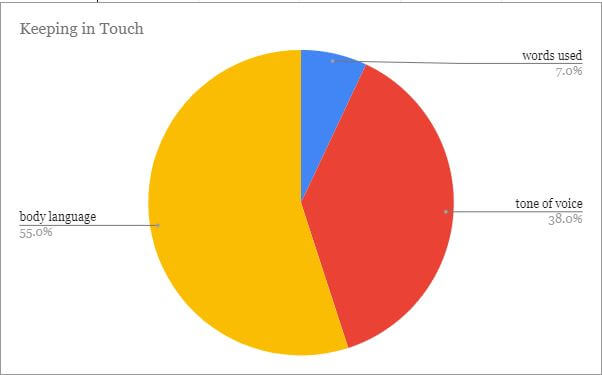
    One of the most difficult things about homeworking is communicating effectively. When we communicate with people face to face, our message is portrayed:

    Keeping in Touch Pie Chart

    Think of the word “yes”, try saying it in different tones. One seemingly straightforward word can mean so many different things.

    We are used to seeing people every day in the office. The longer that does not happen, the more we start to interpret things differently. People can feel left out of key decisions.

    Instead of emailing people, call them. Better still, video chat with them. Seeing a friendly face makes such a difference, especially to someone who is isolating alone. Facetime, Google Hangouts, Zoom – the technology is simple and usually free, even I can use it.

    Throughout this, I will continue to be working as usual so please do keep in touch with me too. I wish you, your families and your businesses, all the very best.

  6. Why your business should think “vegan”

    Comments Off on Why your business should think “vegan”

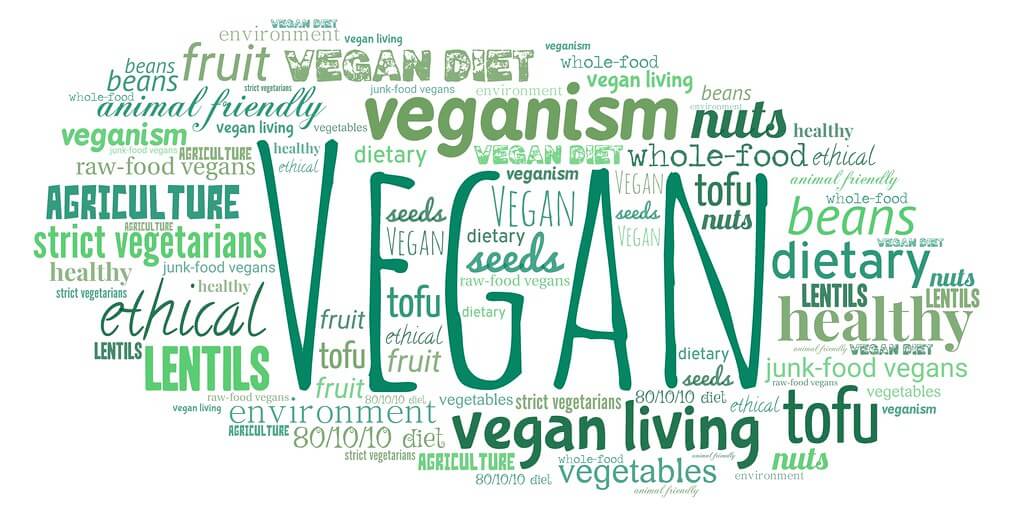
    I am not a vegan myself. Until now, I have given it very little thought. However, an Employment Tribunal has found that you can discriminate against someone because they are an ethical vegan. Perhaps it’s time for you to give this further thought too.

    What is a philosophical belief?

    One of the less well-known forms of discrimination is a philosophical belief. This is a belief that is:

    • genuinely held
    • a belief, not an opinion, based on the present state of information
    • concerns a weighty and substantial aspect of human life and behaviour
    • attains a certain level of cogency, seriousness, cohesion and importance
    • is worthy of respect in a democratic society; is compatible with human dignity and the fundamental rights of others

    Ethical veganism was found to be a philosophical belief.

    What is an ethical vegan?

    An ethical vegan will not use animal products. They will not eat meat or animal by-products. They will not use items made from animal products or that have been tested on animals.

    Is the court finding legally binding?

    This decision is not legally binding on other courts.  However, it does indicate what they may decide. Other beliefs, such as climate change, may soon follow suit.

    What do I need to think about?

    The number of UK vegans is increasing, look at any restaurant menu.

    This may become a real issue at recruitment. Let’s say your uniform contained wool or leather. What if your vegan employee refused to wear it? If you took disciplinary action, it could be discrimination.

    Areas to think about are:

    • uniform and PPE options
    • catering options
    • leather and wool furniture
    • have soaps and products been animal tested?
    • pension fund options (if applicable)
    • dealing with any jokes or banter that may be offensive

    How far do I need to go?

    You may find it easy to offer alternatives. Your non-vegan employees may welcome the changes too. Lots of people choose milk alternatives.

    Vegans are, of course, entitled to their views. However, they also need to respect other people’s opinions. If they act inappropriately regarding others views, you should challenge that. Firstly by talking to them but, if necessary, through disciplinary action.

    Employment law is ever evolving. Employers need to evolve with it, if you would like to know more about this, please contact me.


  7. What do you talk about at work?

    Comments Off on What do you talk about at work?

    Recently Anne Franke, Chief Executive of the Chartered Management Institute, suggested that companies should discourage people from talking about sport. Her suggestion is that it disproportionately excludes women. She also suggested that “it’s very easy to escalate from the VAR talk and chat to slapping each other on the back and talking about their conquests at the weekend.”  Really? I’ve never heard that.

    Those of you who have met me or read my blog before, will know that I am a huge football fan. I can testify that, yes, there are still more men than women in the football stadiums. It’s the only place where women walk straight into the toilets, but men queue for ages. However, there are far more women there now than there used to be when I first started going to live matches. Women’s sport is growing too.  Lots of women like sport.

    Using sport as an example

    A ban on talking about sport at work would be tough on me. I try to explain complex HR ideas using everyday examples.

    When I deal with a conflict between colleagues, I explain that it is often about different perspectives on the same issue. Football is a fantastic example. I support Arsenal. I simply cannot understand why anyone would support Spurs. It’s more than a disagreement – I don’t understand it. Talk to a Spurs supporter and they would say the same thing about Arsenal. We are both looking at the same thing from a different perspective. Each of us is convinced we are right. However, we can often agree on whether something was a good goal or a poor decision. Just like many of the conflicts you see in the workplace, it is about finding common ground and a way to work together.

    The importance of small talk

    One of the biggest problems I come across is people not communicating. If people can talk on a personal level, they are much more likely to co-operate in a workplace. Whether that talk be about sport, TV, hobbies, whatever, small talk should not be underestimated.

    To censor people from talking about sport, in my opinion, is ludicrous. Unless of course, a day comes that Spurs win a trophy. If that happens, I reserve the right to change my opinion totally.

    In the meantime, Anne Franke’s comments have sparked a debate. However, in my opinion, that’s all it should be. A debate.